

“Market access and purchase orders. Those are two very different achievements. Everything difficult happens between those two things.”
Gavin van der Burgh, founder and CEO of the U.S. Africa Trade Desk, charted the course from market access to purchase orders in a recent Presidential Precinct Global Conversation.
We presented this Conversation exclusively to our Corporate Leaders Program alumni, and now we are pleased to share the recording and highlights from the conversation.
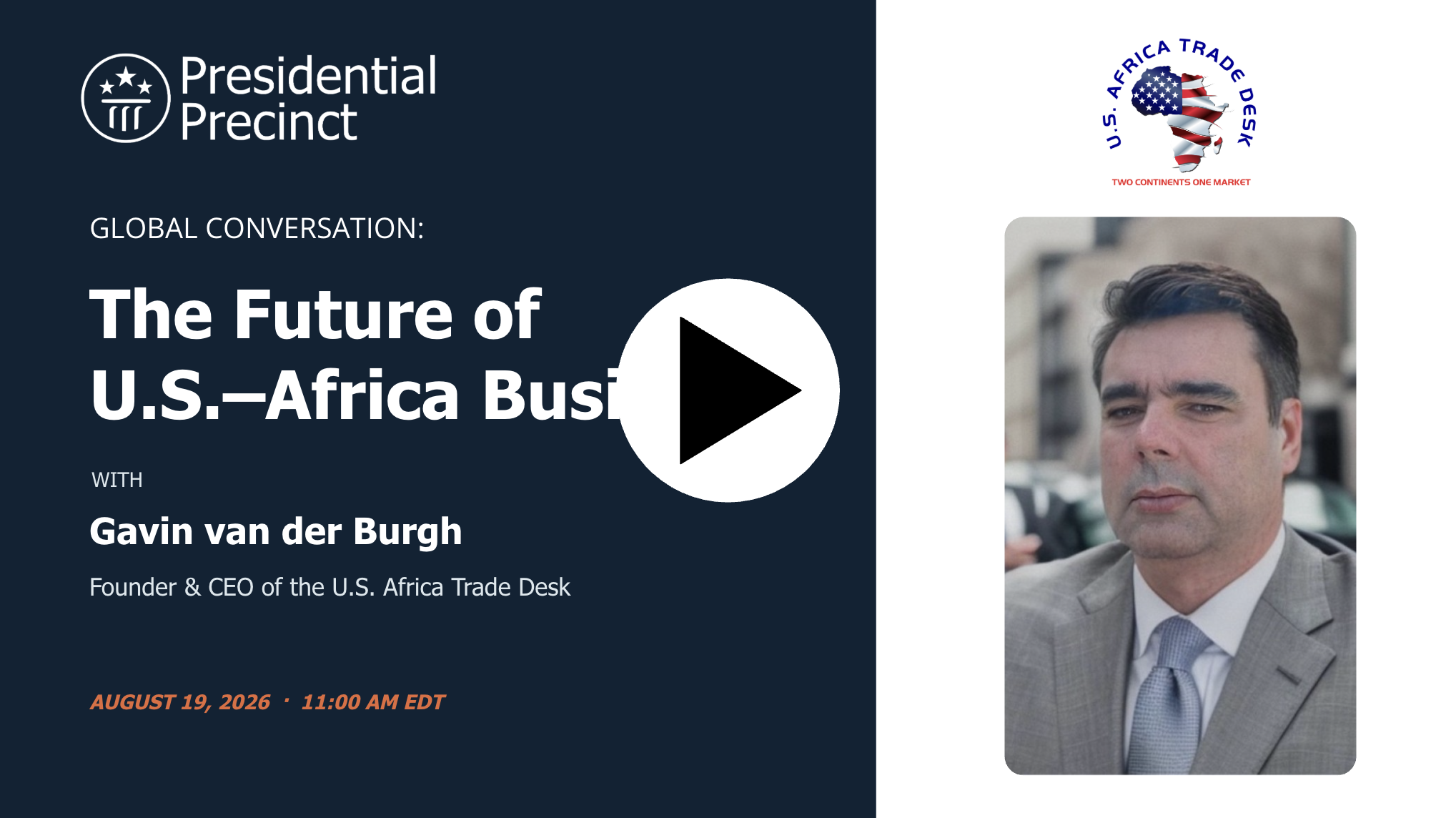
Highlight: What determines if opportunities become orders?
As the centerpiece of his presentation, Gavin guided participants through the stages a buyer works through when evaluating a prospective supplier — which the supplier needs to understand in order to turn hopeful opportunities into real business. Referring to the seven stages as “gates” in a purchase-order readiness journey, Gavin emphasized that “readiness is set by your weakest gate, not your average.” If a supplier fails to satisfy the buyer’s requirements at any gate, they don’t just weaken their chances, they halt progress toward a purchase order.
The seven gates, in order, are 1) verified demand 2) product and compliance 3) landed economics 4) capacity and quality 5) logistics and traceability 6) working capital 7) repeatability.
Realistic expectations and reliability undergird every stage in this process. “A buyer is not buying your maximum,” Gavin said. “They are buying the number you can hit every time without a crisis.” In the end, buyers are looking for reduced risk and the absence of future problems. That’s what will earn a supplier repeat business.
Accessing expertise in U.S.-Africa trade
The conversation showcased Gavin’s expertise in African Growth and Opportunity Act (AGOA), the current tariff environment, the realities of the U.S. market, and other knowledge areas relevant to African business leaders. This kind of expertise is what has made the U.S. Africa Trade Desk a hub for business connection. Founded in 2024 as a public-private partnership between Prosper Africa and Afritex Ventures, the U.S. Africa Trade Desk exists to reshape the commercial landscape between the African continent and the United States.
Today they collaborate with more than 800 vetted suppliers across more than 10 African countries and more than 28 U.S. states. Recent success stories include America’s Cotton, bringing together US cotton farmers and African apparel manufacturers, and a new cashew program, connecting suppliers in West Africa with processors in Florida and Alabama.
The alumni in the audience took advantage of the opportunity to ask incisive questions about general principles and particular business cases.
The Corporate Leaders Program
The Presidential Precinct’s Corporate Leaders Program, an accelerator for African business leaders committed to social impact, was launched in 2024 with the support of Axxess. The Fellowship provides academic, professional, and practical leadership training for business leaders across the African continent. At the heart of the Fellowship is a custom business masterclass at the University of Virginia’s Darden School of Business, the #1 global public business school in the world.
Corporate Leaders Program alumni represent hundreds of millions USD in annual revenue across sectors such as agriculture, logistics, fintech, medical care, and fashion. Through the programs and connections of the Presidential Precinct, they have returned home from the Presidential Precinct equipped to increase their positive impact in their home communities.
“These leaders have distinguished themselves and their businesses with the hard work and creativity that set many of them as market leaders in their respective economies,” said Toyosi Ogunseye, President & CEO of the Presidential Precinct. “Many of them are self-funded with minimal or non-existent government support or infrastructure. Yet, with a tenacity that the African youth is known for, they employ hundreds of young Africans like themselves, and with the right support, they have the answer to the unemployment pandemic that many African nations are faced with.”
To stay informed about future Presidential Precinct Global Conversations and other opportunities, subscribe to our newsletter.