3 Keys to Civic Engagement that Builds Thriving Communities
It’s the beginning of peak season at the Presidential Precinct, with programs and new partnerships in full swing. My team and I have been reviewing hundreds of applications for two upcoming programs. While reaching out to partners for support in this process, I was once again reminded that the work we do is only made possible through healthy communities and ethical leadership. Behind every successful initiative and meaningful gathering is a host of people and organizations who share in the Presidential Precinct’s vision, mission, and values.
I am convinced that communities truly thrive when people at every level are engaged and committed to three things: collaboration, accountability, and investment.
Collaboration supports innovation and problem solving
Collaboration is essential. No one group or leader has all the answers to the complex challenges our communities need to overcome for their growth. From the strengthening of the rule of law to stronger economies and effective healthcare systems, the answers lie in bringing the best ideas to the table, leaving room for healthy debate, and ownership of objectives. This is the model the Precinct thrives on in our decade-long partnerships with the University of Virginia, William & Mary, Thomas Jefferson’s Monticello, James Madison’s Montpelier, and James Monroe’s Highland. Leveraging the institutional strength of these great universities and presidential sites, we are able to incubate the best ideas and accelerate promising leaders.
In the past few months, we have worked with the U.S Chamber of Commerce Foundation, National Center for State Courts, and U.S. Judicial Conference Committee on International Judicial Relations to build a peer-to-peer exchange between international judges and U.S. judges. We are four organizations with a shared aim of promoting the rule of law as a key driver for national development and economic prosperity.
Locally in our hometown of Charlottesville, partners like the Community Investment Collaborative and Tom Tom Foundation enrich our ecosystem with their deep roots and network of solution providers for both domestic and global audiences.
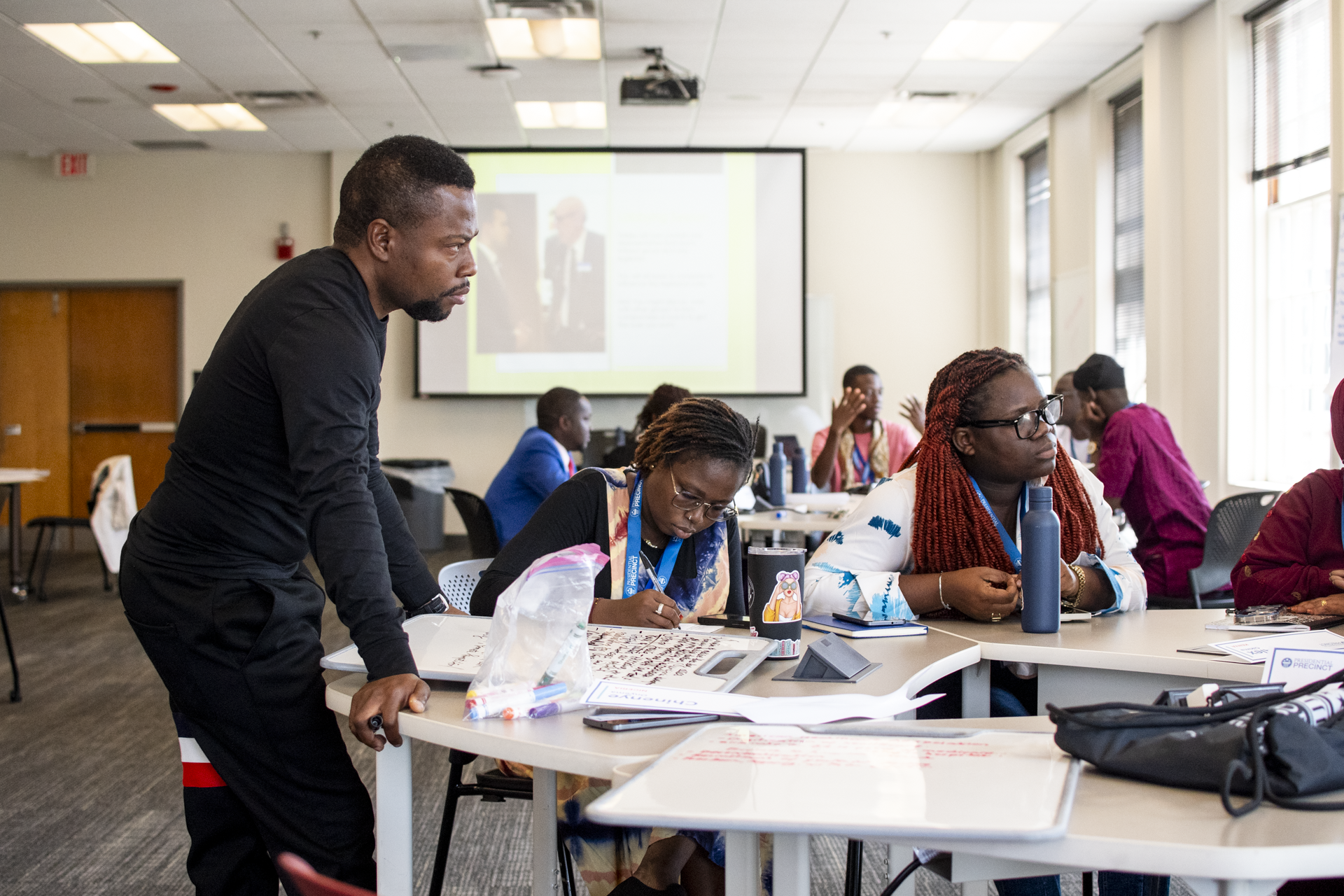
2025 Mandela Washington Fellows collaborate in an exercise on effective governance.
Collaboration also breathes new life into old ideas. We’ve seen this in our partnership with the Colonial Williamsburg Foundation to create a successor program to the State Department’s Mandela Washington Fellowship: our new Global Democracy Fellowship. This new collaboration is showing that legacies can retain their strengths and impact when communities come together with aligned goals.
Accountability builds trust and participation
The glue that often holds collaboration together is accountability. With accountability comes trust, greater participation, stronger systems, and better outcomes. Accountability calls for transparency that exposes both conscious and unconscious bias and transforms passive observation to active participation.
We must see accountability as more than speaking truth to power. It is an opportunity for community members, partners, and citizens to enact ideas that improve public decision-making and service. In my former job as a journalist, I observed how nothing drove citizen participation more than fora where citizens could engage and debate leaders on matters most dear to them. This transparent interaction between people and power ensured greater trust between parties and better governance for the community.
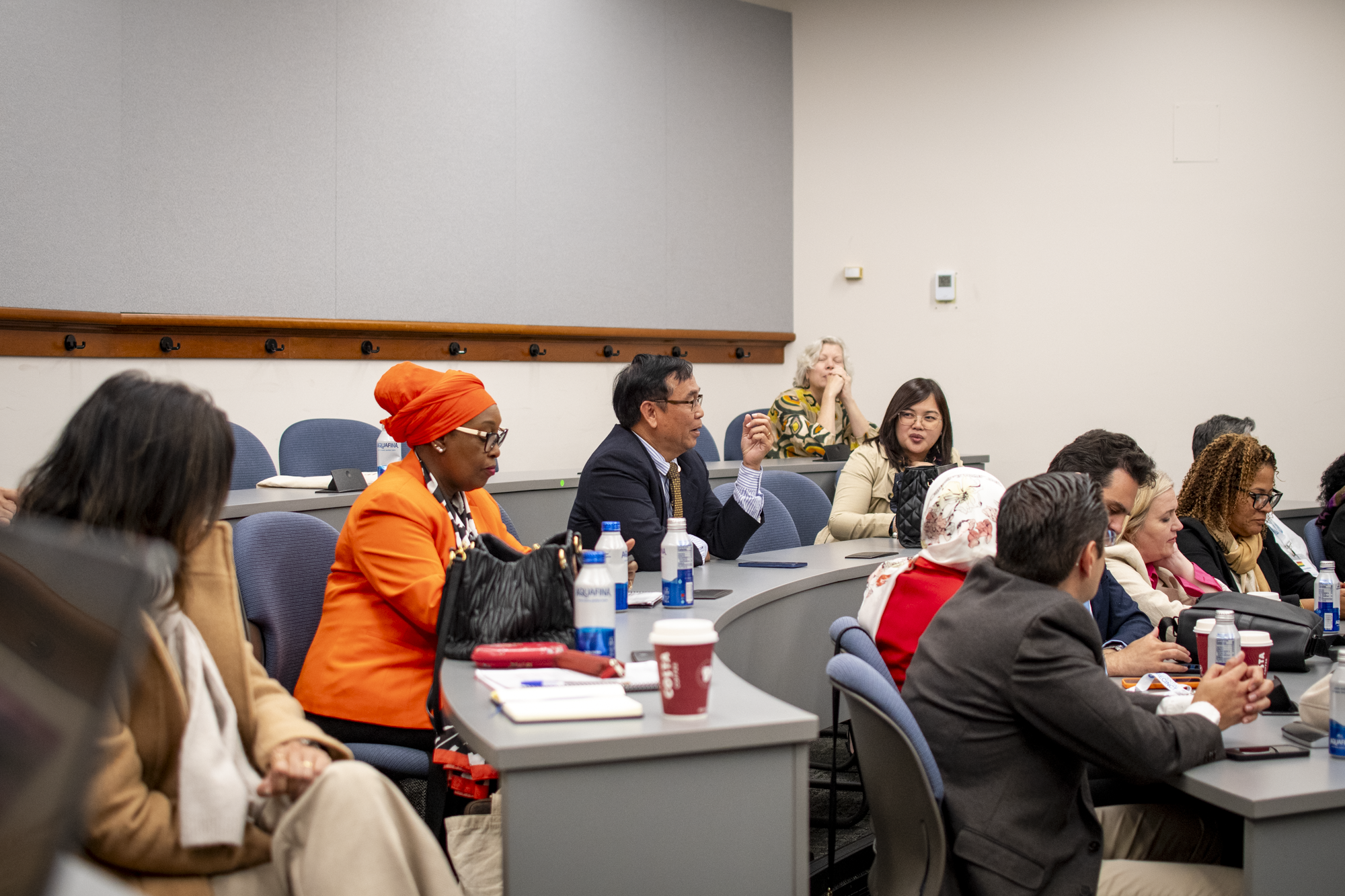
2025 Judicial Fellows converse with students from the University of Virginia School of Law.
This holds true even in corporate and non-government spaces. One of the most common questions in our own team meetings is, “Why are we doing this?” While on the surface, it is a question of purpose, further interrogation often lays bare motives and leads to healthy debate, refining of ideas, and birthing of new goals. And that is the whole point.
Investment activates communities for greater impact
When accountability is met with greater investment from all involved, it creates a cycle of trust, transparency, and efficacy. We must invest in leaders. We must invest in our communities. We must invest in our institutions. At the core of the Presidential Precinct’s mission is finding and investing in the world’s rising leaders and equipping them to serve their communities well. These leaders form life-long relationships and return home to impact hundreds or thousands of people in their domains.
One such leader is AlaSan Ceesay, a Gambian entrepreneur and alumnus of the Presidential Precinct’s Corporate Leaders Program. Through his company, Rahma Gambia Ltd., AlaSan is tackling one of the most pressing challenges facing many communities: food security. His vision goes beyond business success — he is working to build stronger local markets, support farmers, and create jobs that strengthen economic resilience in The Gambia.
Leaders like AlaSan demonstrate the multiplier effect of investing in people. When one leader is empowered with the tools, networks, and ideas to lead well, entire communities benefit from the opportunities they create.
Continuing to build civic engagement
Working with a team and partners devoted to these principles of civic engagement makes it all worth it. Interestingly, there is never really an arrival point with these notions of collaboration, accountability, and investment. All for the better — the possibilities are as great as our shared vision.